
Should steel roof deck be designed using components and cladding wind pressures or main wind force resisting system wind pressures? How should uplift pressures be combined with roof diaphragm shear and are fasteners considered part of the components and cladding or MWFRS?
In the June 2026 SEU Session, Thomas Sputo, PhD, PE, SE, from Sputo and Lammert, LLC and the Steel Deck Institute, presented SDI Tech Notes Live. Tom touched on the content of each SDI tech note. He specifically addressed some commonly asked topics such as wind loads on roof decks, attaching steel deck diaphragms to non-steel supports, as well as appropriate application of AWS D1.3 welding criteria. Tom shared tips and references for using the SDI Tech notes and noted future tech notes in the works.
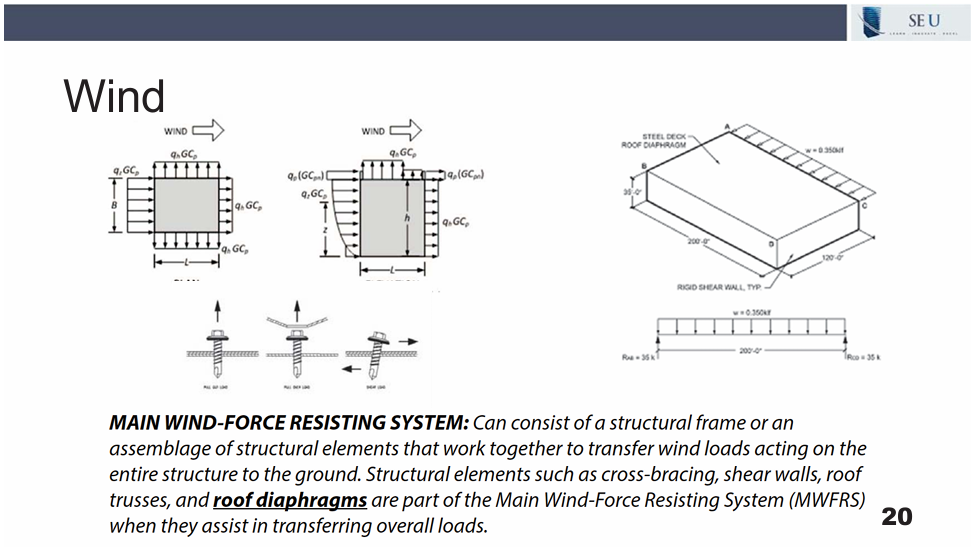
Tom provided a useful clarification for engineers designing roof decks to resist wind shear and uplift forces. Confusion often surrounds whether a structural component or fastener should be designed using Components and Cladding wind pressures or MWFRS wind pressures. As shown in the slides below, Tom clarified when to use each wind pressure according to ASCE7.
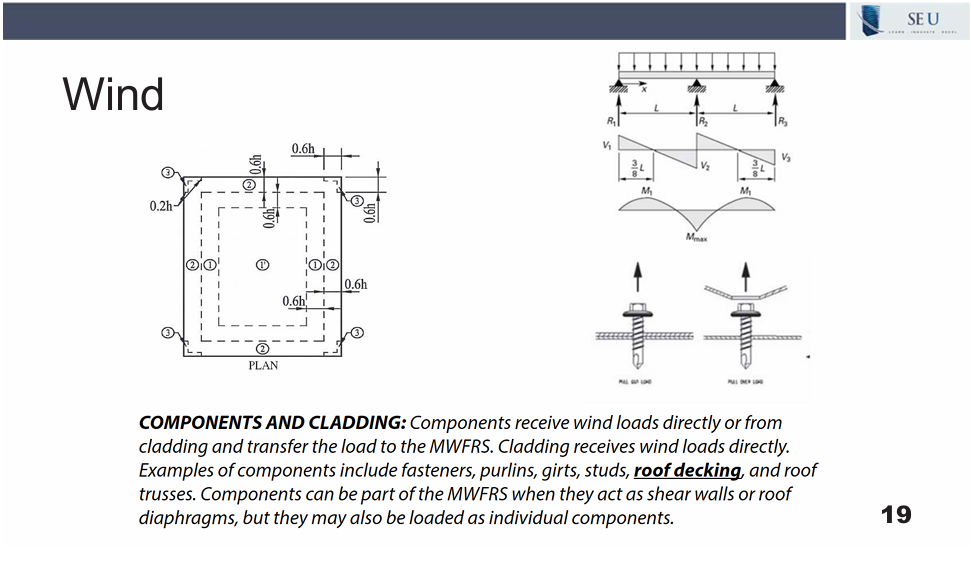
As you can see in Slide 19, ASCE7 notes that fasteners and roof decking are examples of components, and that components receive wind loads from cladding. These components, fasteners and roof deck, may also be part of the MWFRS when acting as part of the roof diaphragm, but also as individual components. Thus, Tom noted that fasteners and roof panels should be designed for the components and cladding uplift roof pressure specified in ASCE7 which tend to be higher than the MWFRS uplift pressures.
Slide 20 notes that the roof diaphragm is considered as part of the MWFRS. Since the fasteners must transfer both the diaphragm shear and wind uplift, they should be designed for the combined loading. However, it is important to note that the code only requires the combined loading to use the MWFRS uplift pressures with the diaphragm shear, and not the components and cladding uplift pressures with the diaphragm shear. Tom noted this would be overly conservative and would result in a less efficient, more costly design.
To learn more about wind pressures, as they apply to steel roof deck and their components, SDI Tech Note 1: C&C or MWFRS Pressures for Steel Roof Deck is available as a free download from the SDI website by clicking the above link.