
New equations are in store for those engineers using ASCE 7-22 to determine design rain loads. Are you familiar with all of the changes included in Chapter 8?
In the February 2026 SEU Session, Scott Russell, SE, PE, from Vulcraft, presented ASCE/SEI 7-22 Snow & Rain Loading with Suggestions on Joist Specification. Scott described significant updates to the snow provisions in ASCE 7-22 and identified new provisions for thermal factors, snow drift heights and windward drifts widths and how to apply them. He also explained the revised rain load calculation methodology in Chapter 8 and reviewed how to specify joists and joist girders for these new changes to ASCE 7-22.
Scott addressed the major update to the modified design rain load calculation which now includes ponding head and uses an updated return period based on risk category. The most significant change appears in Equation 8.2.1, which includes dp which is a ponding head equal to the depth of water due to deflection of the roof subjected to unfactored rain load and unfactored dead load. As you can see in the slide below, dp develops after the Primary drain is clogged, the hydraulic head has formed to achieve drainage through the Secondary Drainage System, and the roof deflects under the additional ponding rain load, creating the Ponding Head, dp.
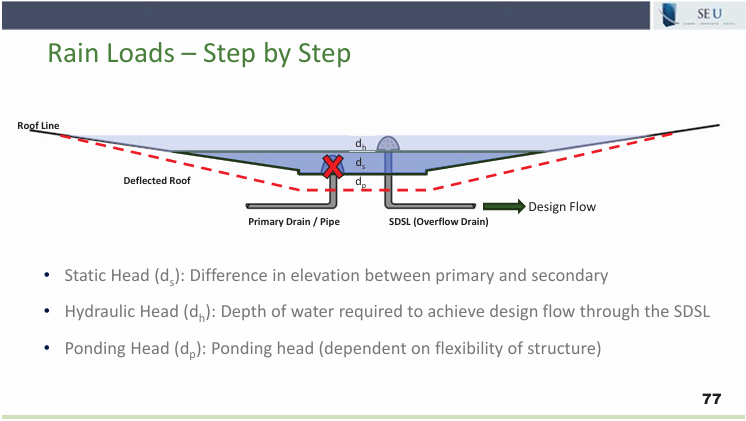
In the past, the Return Period for rain events was 100 years in all cases. ASCE 7-22 has included changes to the Return Period based on Risk Category. Risk Category III now uses a 200 year Return Period and Category IV uses a 500 year Return Period, as shown in Table 8.2-1. The hydraulic head, dh, can then be calculated using Tables C8.2-1 and C8.2-3 depending on the type of secondary drain used.
The Ponding Head, dp, can then be calculated through an interactive approach. Scott recommends using the free and newly updated SJI Ponding Analysis Tool which can be accessed by clicking on the link. Scott also referenced the research performed by Mark Denavit in 2019 which appeared in Engineering Structures and can guide the user through the amplified first-order analysis.
Scott noted other small changes to Section 8.3 Bay with Low Slope which directs the user where to expect ponding, and Section 8.4 which warns against drainage systems for new construction discharging water onto existing roofs unless the existing roof is re-evaluated and/or modified to support the new loads,
The new changes to the rain loads in ASCE 7-22 provide the method to determine the new Design Rain Load and offer guidance on roofs that may be susceptible to ponding. Be sure to check out the most recent version of the SJI Ponding Analysis Tool to assist your future roof designs and reduce calculation time for this new iterative analysis.